Identifying Microbiologically Influenced Corrosion. What can microbiological tests tell us, and what is required for a reliable diagnosis?
By Judit Knisz, PhD
Published on: September 20, 2026
Updated on: September 18, 2026
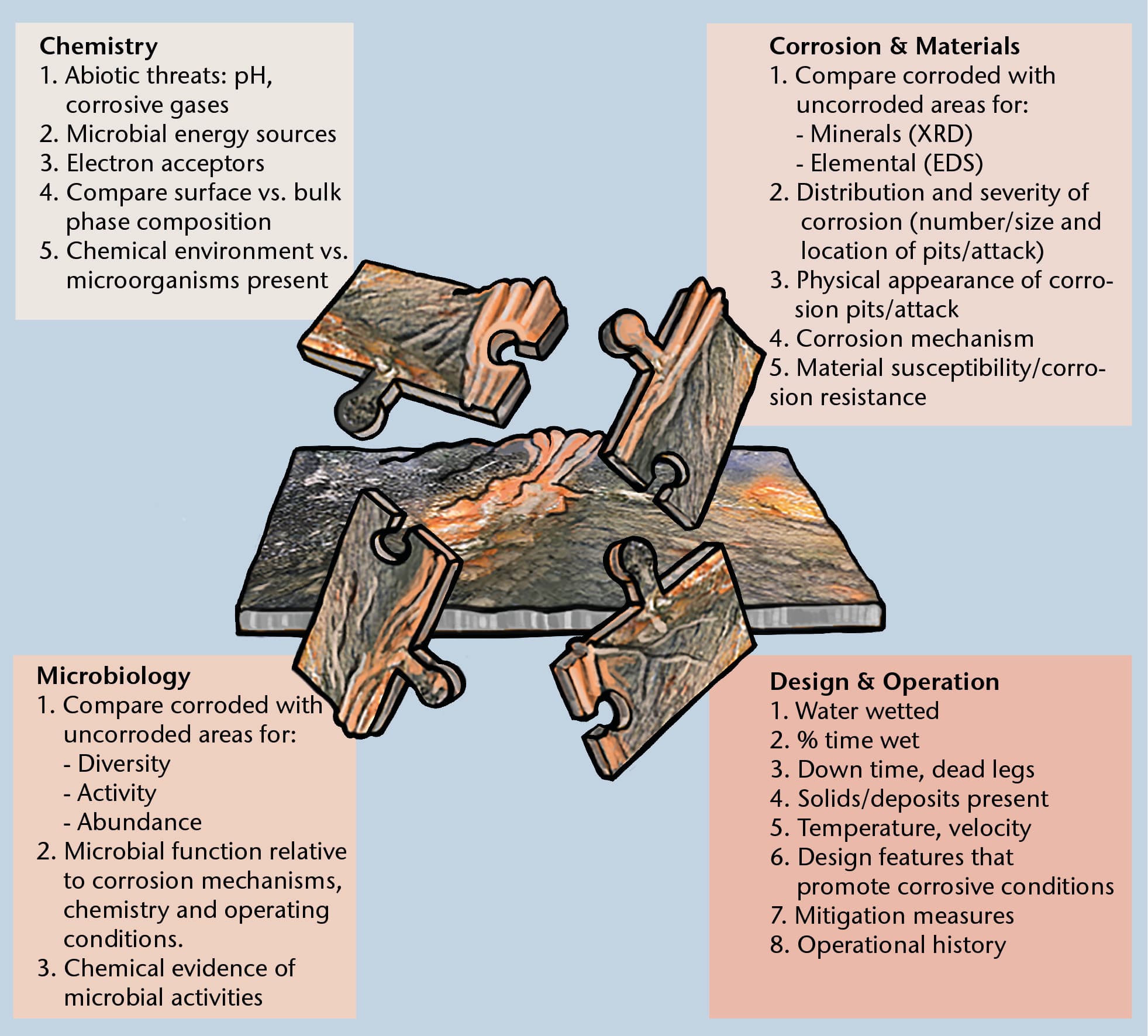
Microbiologically influenced corrosion (MIC) is one of the most complex corrosion phenomena encountered by industrial operators. Corrosion results from interactions between a metal and its environment. In MIC, however, the biological components of that environment, namely microorganisms and the biofilms they form, can actively influence the process. Microbial communities are constantly changing and adapting to physicochemical and operating conditions, while also modifying the immediate environment at the metal surface. It is therefore often difficult to demonstrate directly the extent to which microorganisms have contributed to the observed damage. For this reason, MIC diagnosis can no longer be based on a single test method or an isolated laboratory result.
Even today, MIC is sometimes diagnosed in industrial practice on the basis of a positive result for sulfate-reducing bacteria (SRB) or a high microbial count. The problem is that microorganisms can be found in almost every industrial system. They may be present in cooling water, oil and gas systems, drinking water networks and firewater systems. The key question is therefore not whether microorganisms are present, but whether their presence or activity actually influenced the corrosion that developed. No single test can answer this question on its own.
Research over recent decades has therefore led to a different way of approaching the problem: the Multiple Lines of Evidence, or MLOE, approach. MLOE is based on the combined evaluation of several independent lines of evidence when determining whether MIC has occurred. The investigation must consider not only the microbiological conditions, but also the metal surface, the nature of the damage, corrosion products and deposits, as well as the chemical, physical and operating conditions. The more independent lines of evidence that support a mechanism consistent with microbial involvement, the stronger the technical basis for determining the role of MIC.
Microbiology naturally remains central to this process, but the methods used to examine microbial communities have advanced considerably. Traditional culture-based methods formed the basis of MIC monitoring for many years. They are relatively inexpensive and straightforward, but they have a fundamental limitation: only a small fraction of natural microbial communities can usually be cultured under routine laboratory conditions. Consequently, the results describe only part of the community. In many cases, therefore, traditional most probable number (MPN) results show only a weak relationship, or no relationship at all, with the actual corrosion damage. The value of microbiological results is also strongly influenced by how and where samples are collected. Because the processes influencing corrosion generally occur at the metal-biofilm interface, samples taken from the metal surface, biofilm or deposits are usually more relevant than samples taken from the bulk fluid. Whenever possible, a comparative sample should also be collected from a nearby non-corroded area exposed to similar conditions.
The limitations of traditional culture-based techniques have driven the increasing use of molecular microbiological methods (MMM) in MIC diagnosis. Quantitative polymerase chain reaction, or qPCR, is now one of the most important tools used in industrial microbiology. It can be used to target, detect and quantify groups associated with MIC, such as sulfate reducers, methanogens and nitrate reducers, as well as specific functional genes. The method is rapid, sensitive and reproducible, but it detects only the target groups or genes for which the assay was designed. Moreover, detecting DNA does not in itself prove that the microorganism was active at the time of sampling or that it participated in the corrosion process.
Sequencing technologies represents the next step. Rather than simply indicating whether a particular microorganism is present, they can reveal the composition of the wider microbial community. This is particularly important because MIC can rarely be attributed to a single species. Biofilms are complex ecosystems in which different microorganisms interact. Some organisms produce acids, others generate sulfide, while still others may contribute to corrosion through direct electron transfer. Examining the community as a whole can therefore provide far more information than targeting a single microbial group.
Shotgun metagenomics is currently among the most comprehensive molecular approaches. It can provide a detailed picture of community composition and, based on the genes present in the sample, indicate the community’s functional potential, meaning the metabolic functions it may be capable of performing. This is a major advance, but it is important to distinguish potential from actual activity. The presence of a gene does not necessarily mean that it is being expressed or that the associated process was occurring at the time of sampling. Methods that examine active gene expression, the proteins being produced or the end products of metabolism, including metatranscriptomics, metaproteomics and metabolomics, can provide more direct information about what the community is actually doing. However, these methods are not yet widely used in industrial MIC investigations. One reason is that the proper collection, preservation, transport and processing of environmental samples present considerable methodological challenges.
From a corrosion perspective, therefore, identifying the microorganisms by name is not necessarily the most important objective. What matters is understanding which processes the community is capable of carrying out and which of those processes are active in the system.
Even so, microbiology is only one part of the story. Microbiological results are not sufficient on their own. Examination of the metal surface, the morphology of the damage, and the corrosion products and deposits is equally important. Mineral phases such as various iron sulfides or siderite (FeCO₃) can provide valuable information about the underlying processes, but none of them can be regarded as conclusive evidence of MIC on their own. The same or similar corrosion products may form through either biotic or abiotic processes. Energy-dispersive X-ray spectroscopy (EDS), X-ray diffraction (XRD) and Raman spectroscopy therefore provide the greatest value when their results are evaluated together with the microbiological, chemical and operating data.
Assessing the chemical and physical characteristics of the environment is just as important. Microorganisms require suitable conditions to function. Parameters such as pH, dissolved oxygen, sulfate, nitrate, organic acids and available carbon sources have a fundamental influence on community composition and activity. Flow conditions, temperature and the presence of deposits may also be decisive. In many cases, a stagnant zone, dead leg or the microenvironment beneath a deposit creates the conditions that allow MIC to develop. At the same time, chemical parameters measured in the bulk fluid may differ significantly from the conditions beneath the biofilm at the metal surface. These data must therefore also be interpreted with care.
MIC diagnosis therefore resembles a forensic investigation far more than a conventional laboratory test. The objective is not to find a single “conclusive” result, but to connect the different lines of evidence. Modern molecular microbiological methods are extremely valuable tools in this process, but their true value emerges only when they are interpreted alongside corrosion, materials, chemical, physical and operating information. Evaluating individual laboratory results in isolation is not enough. The process requires a professional with expertise in MIC who understands the capabilities and limitations of the methods used, can integrate data from different disciplines into a coherent assessment, and can weigh biotic, or microbiological, mechanisms against abiotic, or non-biological, corrosion mechanisms. The value of the MLOE approach lies not merely in the quantity of data collected, but in their expert integration.
This approach is now a fundamental principle not only in scientific research, but also in modern industrial MIC diagnosis.
Reliable identification of microbiologically influenced corrosion cannot be based on individual test results alone.
The relationships between these results must be interpreted by appropriately qualified experts with a thorough understanding of how the system operates.